
Sometimes anxiety begins long before anything has actually happened.
A difficult conversation may still be several days away, yet your mind is already rehearsing what you might say and imagining how the other person could respond. For someone who experiences flight anxiety, a trip booked for next month may already bring thoughts about turbulence, delays, feeling trapped, or everything that could possibly go wrong. The Sunday Scaries can begin in a similar way, with anxiety about Monday showing up hours before the workweek has actually started.
This experience is often referred to as anticipatory anxiety. It describes the worry, fear, or physical uneasiness that develops when you begin thinking about something that has not happened yet. The anticipated event may genuinely be stressful, or it may be something you have successfully handled many times before. Either way, the mind and nervous system can begin reacting as though the future situation is already unfolding.
For some people, anticipatory anxiety is relatively brief and settles once the event begins. For others, it can take up hours, days, or even weeks beforehand. Over time, the anticipation itself may become more emotionally exhausting than the experience they are actually worried about.
What Is Anticipatory Anxiety?
Anticipatory anxiety happens when the mind begins looking ahead and preparing for a situation it believes could be difficult, uncomfortable, unpredictable, or threatening.
You may imagine what could go wrong, mentally rehearse different outcomes, search for reassurance, or feel compelled to prepare for every possibility. The body can become involved as well, creating a racing heart, tight stomach, muscle tension, restlessness, shallow breathing, or a feeling that you cannot fully settle.
Sometimes the source of anticipatory anxiety is easy to recognize. An upcoming job interview, medical appointment, flight, presentation, social gathering, or difficult conversation may naturally bring some uncertainty about what to expect or how the experience will unfold.
At other times, the intensity of the reaction may feel confusing. You may recognize logically that you are probably going to be okay while another part of you feels as though something needs to be prevented, controlled, or solved before it happens.
Anticipatory anxiety can appear in many different situations, including:
- Going to work after the weekend
- Flying or traveling
- Attending a medical or dental appointment
- Speaking in front of others
- Waiting for test results or important news
- Starting a new job
- Going on a date
- Making an important decision
- Preparing for an event where you feel uncertain or out of control
The specific situation may be different, but the underlying pattern is often similar. The mind begins looking ahead, while the body starts responding to what might happen before there is anything in the present moment that actually needs to be managed.
Why Does Anxiety Begin So Early?
 The brain is designed to anticipate. Being able to think ahead helps us plan, prepare, solve problems, evaluate risk, and protect ourselves. A certain amount of anxiety before something important can be useful because it helps us focus and think through what needs our attention.
Difficulty can begin when thoughtful preparation shifts into repeatedly anticipating what could go wrong. Instead of focusing on the parts of the situation that are actually within your control, the mind may start scanning for every possible outcome, including ones that are unlikely or impossible to predict. What begins as an effort to feel prepared can gradually become an attempt to create certainty, leaving you mentally engaged with the future long before you have enough information to know what will actually happen.
Instead of simply thinking, I have a presentation tomorrow, so I should review my notes, your thoughts may move toward:
- What if I freeze?
- What if I embarrass myself?
- What if someone asks a question I cannot answer?
- What if everyone notices that I am anxious?
One possibility can quickly lead to another. A thought about what could happen becomes a mental simulation of what might happen next, followed by another scenario that also seems to require preparation.
Before long, the mind is no longer helping you prepare for an event. It is attempting to prepare you for every possible version of the future, including situations that may never occur. That can become exhausting because no amount of thinking can create complete certainty about something that has not happened yet.
When The Body Reacts To What The Mind Is Anticipating
Anticipatory anxiety is not only a pattern of thinking. The nervous system and body can begin responding to an imagined future as though something important is already happening in the present.
You may notice tension through your shoulders or jaw, pressure in your chest, nausea, digestive discomfort, difficulty sleeping, headaches, sweating, shakiness, restlessness, or a general sense of being unable to fully relax. Some people describe feeling as though they are constantly waiting for something to happen, even when they are technically safe and nothing requires their immediate attention.
The nervous system may become more alert because the brain has identified something ahead as potentially threatening. Each time you think about the upcoming event, the body may receive another signal that it needs to prepare.
This is one reason simply telling yourself to “stop worrying” often has limited effect. Your logical mind may understand that nothing is happening right now, while your body has already begun responding to what it believes may happen later.
Learning to work with anticipatory anxiety can therefore involve a lot more than changing anxious thoughts. It may also mean helping the body recognize the difference between thinking about a future event and experiencing danger in the present moment.
Sometimes The Anticipation Feels Worse Than The Event
One of the more confusing parts of anticipatory anxiety is that the period leading up to an event can sometimes feel significantly harder than the event itself. The mind may spend hours or days imagining possible outcomes, while the body remains activated in response to situations that have not yet occurred. By the time the actual moment arrives, you may discover that the experience is far more manageable than everything you had been anticipating.
You may spend several days worrying about an important meeting and discover that once it begins, you are able to respond naturally. You might feel anxious for weeks before a trip but become noticeably calmer once you are actually on your way. A conversation may be rehearsed repeatedly in your mind, yet when the moment comes, the interaction feels much more manageable than the version you had imagined.
Part of this may be related to uncertainty. Before an event takes place, there can seem to be countless possible outcomes. The mind has very little concrete information to work with, so it may begin filling in the gaps with predictions.
Once the event begins, there is finally something real to respond to. Instead of trying to anticipate twenty different possibilities, you can begin responding to what is actually happening in front of you.
For some people, recognizing this pattern can be an important part of understanding their anxiety. The discomfort they feel before an event is not always evidence that the situation itself is unsafe or unmanageable. Sometimes it reflects how difficult it has become to sit with uncertainty before knowing what comes next.
The Search For Certainty

Anticipatory anxiety often creates a strong desire to know exactly what is going to happen. You may research excessively, check plans repeatedly, ask others for reassurance, mentally rehearse conversations, arrive extremely early, overprepare, or try to predict how everyone involved might respond. These behaviors can feel responsible and productive because they create a temporary sense of control.
A certain amount of preparation can be helpful and grounding. Knowing the route before driving somewhere new can help. Preparing for an interview makes sense. Asking questions before a medical procedure may provide information that genuinely supports you.
The difficulty begins when preparation no longer leads to a greater sense of readiness. Instead, there is always one more detail to check, one more opinion to ask for, or one more scenario that needs to be considered before you can relax. At that point, the search may be less about gathering useful information and more about trying to eliminate uncertainty entirely. When certainty remains out of reach, the mind may keep searching for one more answer, detail, or reassurance that will finally make the anxiety settle.
Part of working with anticipatory anxiety may involve learning that you can prepare thoughtfully while still allowing some parts of the future to remain unresolved. You can take meaningful steps, gather the information you need, and make reasonable plans without having to account for every possible outcome. Over time, this can help create more trust in your ability to respond to what happens when it actually happens, rather than feeling responsible for solving the future in advance.
Avoidance Can Quietly Strengthen Anticipatory Anxiety
When something creates significant anticipatory anxiety, avoidance can bring an immediate sense of relief. You cancel the appointment, decline the invitation, change the travel plans, put off the conversation, take a different route, or decide not to pursue an opportunity. Once the situation is removed, the anxiety may decrease quickly.
That relief can feel powerful. The nervous system may interpret the drop in anxiety as confirmation that avoiding the situation was what kept you safe. Without experiencing the situation itself, there is no opportunity to learn whether the feared outcome would actually have happened.
Over time, similar situations may begin producing anxiety sooner or with greater intensity. The world can gradually become smaller as more decisions are organized around avoiding the discomfort that comes before an uncertain experience.
This does not mean that every uncomfortable situation should be forced or pushed through. Choosing not to do something can be thoughtful, healthy, and appropriate. The more important question may be whether the decision reflects what you genuinely want and need, or whether anxiety has gradually begun making more of those choices for you.
Anticipatory Anxiety And The Need To Mentally Rehearse
 Some people respond to uncertainty by repeatedly practicing future conversations in their minds. You may imagine what another person might say, plan your response, and then create an entirely different version of the interaction that also needs to be rehearsed.
Mental rehearsal can feel productive because the mind is actively doing something. It creates the impression that if you think through enough possibilities, you may be able to prevent embarrassment, conflict, rejection, or uncertainty.
There is a point, however, where preparation can turn into rumination. Rather than helping you feel more ready, repeated rehearsing may keep your mind and nervous system connected to a conversation that has not happened.
You can spend an entire evening emotionally participating in an interaction that currently exists only in your imagination. By the time the real conversation arrives, you may already feel depleted from having lived through so many possible versions of it.
It may help to ask yourself: Am I preparing for something I can realistically plan for, or am I trying to guarantee an outcome I cannot control? The answer may not always be immediately clear. Simply beginning to notice the difference between useful preparation and repetitive prediction can create more room for choice.
When Past Experiences Shape Future Expectations
Anticipatory anxiety may also be influenced by previous experiences. If you have felt embarrassed during a presentation, panicked while driving, received frightening medical news, experienced intense turbulence on a flight, been criticized at work, or felt emotionally unsafe during conflict, your nervous system may remember more than the details of what happened. It may also remember how vulnerable, overwhelmed, trapped, or unprepared you felt in that moment.
A present-day situation does not have to be identical for the body to recognize something familiar. A similar setting, sensation, relationship dynamic, or loss of control may be enough to activate an older expectation. The nervous system may begin preparing for the possibility that something similar could happen again.
Viewed through this lens, anticipatory anxiety may make more sense as a protective response rather than something irrational or inexplicable. A part of you may be trying to prevent a repeat of something that once felt overwhelming.
Understanding where that expectation came from can be helpful because it allows you to hold both realities at once. The response may have a meaningful history, while the past does not necessarily have to predict what will happen next.
What Can Help With Anticipatory Anxiety?
There is rarely one strategy that works for everyone. Anticipatory anxiety can involve thoughts, nervous system responses, past experiences, uncertainty, avoidance, reassurance seeking, and patterns of trying to remain in control. An integrative approach may therefore include several different ways of responding, depending on what seems to be maintaining the anxiety.
1) Come Back To What Is Happening Now
Anticipatory anxiety pulls attention into the future, sometimes so convincingly that an imagined event begins to feel emotionally present. Gently orienting yourself toward what is actually happening around you can help create some distance from that future focus. You might notice what you can see in the room, the feeling of your feet against the floor, the temperature of the air, the support of the chair beneath you, or the natural rhythm of your breathing.
The intention is not to convince yourself that the upcoming event does not matter or that you should not care about it. Instead, these practices can help remind your nervous system that the event is not happening right now and that you are allowed to remain connected to the life that is occurring before it.
2) Separate Preparation From Prediction
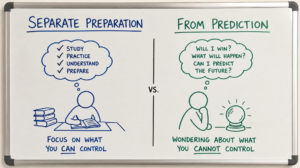 Preparation can be both useful and reassuring, helping you feel more informed, organized, and ready to respond to what is ahead. You can make a plan, gather relevant information, practice what you want to say, organize what you need, or decide what kind of support might be helpful. These are concrete actions that may make an upcoming situation easier to navigate.
Once reasonable preparation is complete, however, continued thinking may not provide additional protection. The mind may simply begin creating more scenarios because uncertainty still remains. It can help to ask yourself, Is there something useful I can do about this right now, or am I trying to solve uncertainty?
If there is a practical action available, taking it may be helpful. If there is nothing left to do, the next step may be practicing how to let part of the future remain unknown until you actually get there.
3) Notice The Story Anxiety Is Creating
Anticipatory anxiety can move quickly from possibility to certainty. A thought such as Something might feel uncomfortable can gradually become Something is going to go badly, especially when the mind keeps returning to the same feared outcome. The emotional response that follows can make that prediction feel even more convincing, even though it is still based on something that has not yet happened.
It can be helpful to notice the story anxiety is creating without feeling that you have to argue with every thought or replace it with something overly positive. A more grounded response may simply involve recognizing what you know, what you do not yet know, and where your mind may be filling in the gaps. You might remind yourself, I am noticing that my mind is predicting a difficult outcome. I do not know exactly how this will go, and I can respond to what happens when I have more information.
This approach does not require you to convince yourself that everything will be fine. Instead, it can create more space between having an anxious thought and treating that thought as evidence of what the future will actually be. Over time, that space may make it easier to stay connected to the present rather than becoming pulled into a story about what might happen next.
4) Support The Nervous System
Anticipatory anxiety often has a strong physical component, which can make nervous system support an important part of responding to it. Movement, slower breathing, mindfulness, time outdoors, stretching, music, connection with another person, preparing a comforting meal, or returning to a familiar routine may help the body reconnect with the present.
These practices are not about forcing the nervous system into perfect calm. Anxiety may still be present, especially when something genuinely important is approaching. The intention is to help the body move in and out of activation more easily rather than remaining in a prolonged state of preparation for hours or days at a time.
5) Reduce Reassurance Loops
Reassurance can be comforting, particularly when anxiety feels intense. Sometimes another person can provide information, perspective, or emotional support that genuinely helps.
The pattern can become more complicated when the same question needs to be answered repeatedly in order for relief to last. You may find yourself asking several people what they think, searching online for another answer, or returning to the same concern whenever the anxiety rises again.
At that point, reassurance may offer short-term relief without addressing the underlying difficulty of not knowing what will happen. It is useful to notice when reassurance is providing helpful information and when it is becoming an attempt to eliminate uncertainty. Over time, building confidence in your ability to handle what comes next offers more lasting support.
When Anticipatory Anxiety Begins To Shrink Your Life
 Anxiety deserves closer attention when it begins influencing what you feel able to do, pursue, enjoy, or experience. Perhaps you avoid travel even though you would like to see new places. You decline opportunities because the days leading up to them feel unbearable. Much of Sunday is spent worrying about Monday, making it difficult to enjoy the remainder of the weekend. Medical appointments are postponed because the anticipation feels overwhelming, or relationships become more stressful because difficult conversations are repeatedly rehearsed and feared before they occur.
Over time, the problem may no longer be one particular event. The anticipation itself can begin shaping how you organize your life. Therapy can offer a place to understand what the anxiety is trying to protect you from, what experiences may have contributed to the pattern, and whether avoidance, reassurance, or overpreparation are unintentionally helping that anxiety stay in place.
How Therapy May Help
An integrative approach can explore what happens cognitively, emotionally, physically, and relationally when uncertainty appears. For one person, the anxiety may be primarily connected to catastrophic thinking. For another, the body may become activated before there are even clear thoughts attached to the fear. Someone else may notice that anticipatory anxiety is strongest in situations that resemble a painful or overwhelming experience from the past.
Therapy may include learning to recognize anxious predictions, strengthening tolerance for uncertainty, reducing avoidance, building greater self-trust, and understanding the nervous system responses that arise before particular situations.
When past experiences continue to shape present-day anxiety, approaches such as EMDR therapy or Accelerated Resolution Therapy (ART) may also be helpful in exploring experiences that continue to feel emotionally active. Somatic and nervous system-informed approaches can support greater awareness of what happens in the body when anticipation begins, while cognitive and mindfulness-based strategies may create more space around repetitive thoughts and future-oriented worry.
The aim is not to eliminate every feeling of nervousness before something important. Some anticipation is a natural response when an experience matters to you. A more meaningful shift may be becoming increasingly able to experience uncertainty without needing to organize your entire day, week, or life around preventing what might happen.
Creating More Space Before What Comes Next
The future will always contain some uncertainty. There will be conversations you cannot completely rehearse, trips you cannot fully predict, decisions without perfect answers, and important moments that naturally bring some nervousness.
Working through anticipatory anxiety does not necessarily mean reaching a place where nothing ahead ever feels uncomfortable. Instead, you may gradually have more space between knowing something is coming and feeling you must immediately prepare for every possible outcome.
You may begin noticing anxious predictions without automatically following them. The body may settle more easily after becoming activated, and preparation may become more intentional rather than consuming. Uncertainty can still feel uncomfortable without carrying the same sense of urgency or danger.
Over time, there may be more room to remain connected to the present while trusting that you can meet the future when it arrives. Rather than emotionally living through an experience over and over before it happens, you may begin allowing yourself to respond to what is actually there, one moment at a time.
If this blog resonated with you, integrative therapy can offer a supportive space to explore the thoughts, nervous system responses, past experiences, and patterns around uncertainty that may be contributing to anticipatory anxiety. You can schedule a phone consultation to begin exploring what may help you feel more grounded in the present and more supported as you approach what comes next. I provide in-person counseling from my Simsbury, Connecticut office and online throughout Connecticut, New Jersey, and Vermont.