Fear of flying can feel embarrassing to talk about, especially because, logically, you may already know that flying is statistically safe. And yet your body doesn’t care about logic when your nervous system is sounding an alarm. The sweaty palms start in the parking garage. Your stomach drops when you hear the boarding announcement. Your mind runs a highlight reel of worst-case scenarios at 30,000 feet.
If this is you, I want you to know two things: you’re not “too much,” and you’re not broken. Flight anxiety is a very human nervous-system response. In integrative therapy, we don’t just try to “think your way out of it.” We work with your whole system, mind, body, memory, and meaning, so that your internal alarm can recalibrate.
In my work with clients, I often combine EMDR (Eye Movement Desensitization and Reprocessing) with practical tools, including The Fear of Flying Workbook by David Carbonell, PhD. Together, these approaches can help you understand what’s happening inside you, reduce anticipatory anxiety, and build real-world confidence, so flying becomes something you can do without feeling hijacked by fear.
Why Fear Of Flying Can Feel So Intense (Even When You “Know Better”)
A fear of flying tends to involve more than one layer:
- The body layer: Your nervous system reads flying as danger and flips into fight/flight/freeze. This can look like a racing heart, dizziness, nausea, tingling, shortness of breath, shaking, or a sense of unreality.
- The thought layer: Catastrophic images and “what if” thinking show up fast: What if we drop? What if I panic and can’t get out? What if I faint? What if something happens to the pilot?
- The control layer: Flying asks you to surrender control in a tight space, with limited exits, and a lot of sensations that can mimic panic (turbulence, engine sounds, pressure changes).
- The memory layer: Sometimes flight fear is connected to a specific experience, turbulence on a past flight, a panic attack that happened midair, a medical scare, or even a totally unrelated event where your body learned I’m not safe and I can’t get away.
- The meaning layer: For some people, flying triggers existential fear such as mortality, vulnerability, or the intensity of “I’m responsible for my family.”
Integrative therapy takes all these layers seriously. The goal isn’t to force you into flying through sheer willpower. The goal is to help your system learn: I can be uncomfortable and still be safe. I can feel anxiety without it becoming danger.
Panic On A Plane Is Not The Same As Danger
 One of the hardest parts of flight anxiety is that the sensations can be so convincing. Your heart races and your brain says, “This is it”. But a panic response is an internal alarm, not proof of external danger.
A lot of flight anxiety is fueled by fear of the fear itself:
- What if I panic and lose control?
- What if I embarrass myself?
- What if I can’t breathe?
- What if I feel trapped?
When we treat the nervous system with compassion and structure, panic becomes less mysterious. And when panic becomes less mysterious, it becomes less powerful.
What An Integrative Approach Looks Like
Integrative therapy gives us a wide toolkit. Depending on the client, we might include:
- Psychoeducation about anxiety, panic physiology, and how the threat system works
- Somatic (body-based) regulation skills to settle the nervous system and interrupt the escalation loop
- Cognitive work to gently challenge catastrophic predictions and black-and-white thinking
- Exposure and skills practice to help your brain update through experience
- EMDR to reprocess stuck memories and body-held fear responses
- Values-based planning so flying becomes connected to what matters (family, freedom, adventure, opportunity)
We go at a pace that’s respectful of your system. This isn’t about “just do it.” It’s about building capacity.
Where I Often Start: Mapping Your Fear Pattern
Before we jump into tools, we get specific. In sessions, I’ll often ask questions like:
- When does your anxiety start: days before, the night before, at the airport, at takeoff?
- What part is hardest: boarding, takeoff, turbulence, cruising, landing, the feeling of being trapped?
- What’s the core fear underneath it all: dying, panicking, losing control, being judged, being stuck?
- Have you had a panic attack on a plane before?
- Are there other places where you feel similarly trapped or out of control (elevators, crowds, highways)?
This “map” matters because fear of flying isn’t one-size-fits-all. Two people can both say “I’m afraid of flying,” and what they mean can be completely different.
Using The Fear Of Flying Workbook By David Carbonell, PhD In Therapy 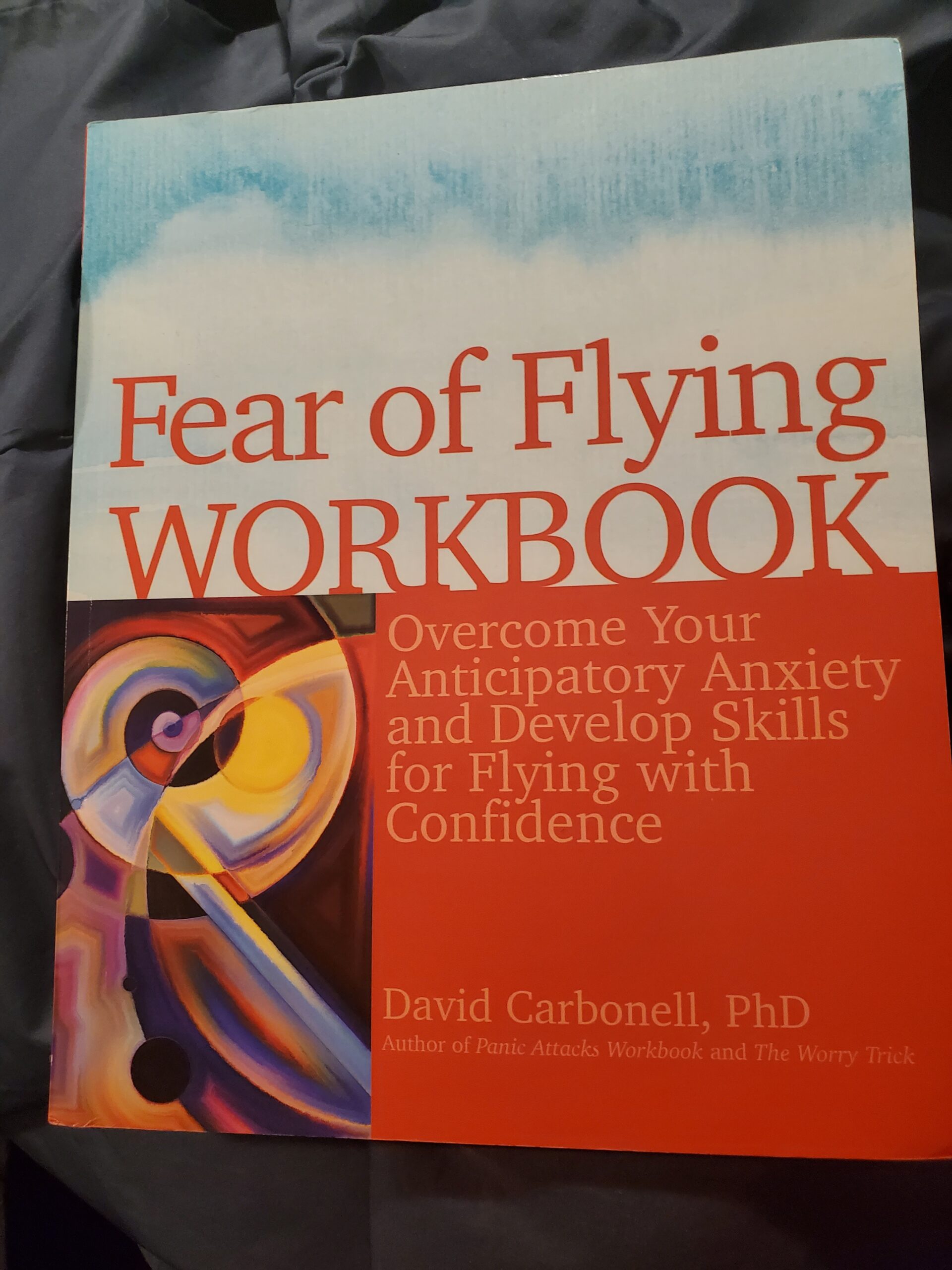
I often recommend this workbook because it’s practical, clear, and grounded in how flight anxiety works. What I like about it (and why it pairs so well with integrative therapy) is that it helps clients:
- Understand the mechanics of flight anxiety and why the body reacts the way it does
- Work with anticipatory anxiety (which can be worse than the flight itself)
- Build skills for turbulence and the uncomfortable sensations that trigger panic
- Shift from “How do I get rid of anxiety?” to “How do I ride it differently?”
In therapy, we might use this workbook to create a structured plan between sessions, almost like a training program for your nervous system. That can include:
- Reading specific sections that match your pattern (panic, turbulence, claustrophobia, anticipatory dread)
- Practicing the exercises consistently (not perfectly)
- Developing a personalized “flight coping menu” (tools for mind, body, and behavior)
- Tracking what changes over time (because your brain needs evidence)
If you’re the kind of person who feels calmer with a roadmap, this workbook can provide that. If you’re the kind of person who avoids thinking about flying at all, this workbook can gently build tolerance for engaging with it, one step at a time.
How EMDR Can Help Fear Of Flying
EMDR (Eye Movement Desensitization and Reprocessing) can be very effective for fears and phobias, especially when the fear is linked to a past experience or when the body’s panic response feels “bigger than the situation.”
Here’s the way I explain it. Sometimes fear of flying isn’t about flying. It’s about a nervous system that learned, at some point, “I’m not safe, and I can’t get away.” That learning can come from:
- A turbulent flight or scary landing
- A panic attack (on a plane or elsewhere) that your brain paired with “danger”
- A medical event (shortness of breath, dizziness, fainting) that made body sensations feel threatening
- A past trauma that involved powerlessness, confinement, or unpredictability
- Growing up with high anxiety around safety, control, or catastrophe
In EMDR, we identify the memories, sensations, and beliefs that keep the fear loop alive and then we help your brain and body digest what got stuck.
What EMDR Targets In Flight Anxiety 
In EMDR, we might work with:
- A specific memory: “That flight where I thought we were going down.”
- A body memory: “The moment my chest tightened and I panicked.”
- A recurring image: “The plane dropping” or “being trapped in my seat.”
- A negative belief: “I’m not safe,” “I can’t cope,” “I’m powerless,” “I’m going to lose control.”
- A future scenario: “The upcoming flight” (using a future template so your system can rehearse calm, capable responses)
As processing happens, the memory often becomes less charged. The body sensations soften. The belief shifts from “I can’t handle this” to something more grounded like: “I can get through discomfort,” “My body can calm,” “I have choices,” “I can cope.” That shift is huge because the fear of flying usually isn’t solved by one brilliant thought. It’s solved by a new felt sense of capability.
Regulation Skills That Help On Travel Day
Integrative therapy is practical. We don’t just process, we also plan.
1) Body-based grounding (fast + discreet)
- Gentle longer exhales (even a subtle slow exhale signals safety to the nervous system)
- Pressing feet into the floor and naming physical sensations (“heel, toe, seat, backrest”)
- Temperature shifts (cool water, a cold cloth, something minty) to interrupt escalation
- Muscle tension release (clench fists for 5 seconds, release for 10)
2) Nervous-system “permission”
Instead of fighting the anxiety (which can amplify it), we practice letting it move through the mind and body.
- “This is anxiety. It’s not danger.”
- “My body is trying to protect me.”
- “I can be uncomfortable and still safe.”
3) Attention strategies
Anxiety narrows attention and scans for threat. We widen it on purpose:
- A playlist that cues safety
- A simple game, podcast, or familiar show
- A grounding object (something tactile, meaningful, anchoring)
4) A turbulence plan
Turbulence is a common trigger because it mimics “falling.” We work on:
- Reframing turbulence as uncomfortable but normal
- Practicing a response phrase (“This is expected. The plane is built for this.”)
- Returning to body anchors: feet, seat, breath, jaw release
None of these are magic tricks. They’re nervous-system retraining tools. You’re teaching your body a new script.
Gradual Exposure With Safety and Support
A lot of people hear “exposure” and think it means forcing themselves onto a plane while white-knuckling the armrests. That’s not what I mean. In integrative therapy, exposure is gradual, titrated, and respectful. It might look like:
- Watching short flight videos while practicing regulation
- Driving to the airport and sitting in the parking lot
- Walking into the terminal and leaving
- Watching planes land and take off
Exposure works best when it’s paired with skills and a compassionate mindset. You’re not trying to prove you’re fearless. You’re proving you’re capable.
How Progress Tends To Unfold
Progress with fear of flying is often subtle before it’s obvious. You might notice:
- You still feel anxious, but you recover faster
- The anticipatory dread decreases from a 9/10 to a 6/10
- You can sit with sensations without spiraling into catastrophe
- Turbulence still bothers you, but it doesn’t convince you that something is wrong
- You stop organizing your life around avoiding flights
And sometimes, yes, clients reach a point where flying becomes a non-issue. Other times, the goal is: I can fly with manageable anxiety and still live my life. Both outcomes are valid. Both are freedom.

If you’re avoiding trips, turning down opportunities, or feeling trapped by flight anxiety, it makes sense to want a clear solution. Using EMDR to reprocess the roots of fear and structured tools like The Fear of Flying Workbook by David Carbonell, PhD, to build skills and confidence can be a powerful combination. It addresses both the why (what your body learned) and the how (what you can do now).
If you have flight anxiety, which is impacting your life, and you are looking for therapeutic support in this area, please schedule a phone consultation to see if these counseling services may be a good fit.