
Love is not only about how we give. It is also about how we receive.
Some people deeply want closeness, partnership, affection, reassurance, and emotional safety. They want to feel chosen, supported, understood, and cared for. Yet when love is actually offered, something inside of them may tighten. They may pull away, minimize their needs, question their partner’s sincerity, become uncomfortable with tenderness, or feel uneasy when someone tries to care for them.
On the outside, this may look like independence, distance, defensiveness, irritability, or emotional unavailability. On the inside, it may feel much more complicated.
Being able to receive love in a relationship means allowing care to come toward you and letting it matter. It means allowing comfort, affection, help, reassurance, and emotional presence to land without immediately pushing it away, explaining it away, or proving that you do not need it. For some people, this feels natural. For others, receiving love can feel unfamiliar, vulnerable, overwhelming, or unsafe.
In couples counseling, this pattern often begins to emerge slowly. One partner may feel hurt and say, “I keep trying to love them, but they will not let me in.” The other partner may say, “I do want love. I just do not understand why it feels so hard to receive it.” Both people can be telling the truth.
Why Receiving Love Can Feel So Vulnerable
Receiving love asks of us something different than giving love. Giving can feel active, familiar, useful, and more within our control. A person can care for their partner, offer support, manage details, and show up in thoughtful ways while still maintaining some emotional distance and staying in the role of the capable one.
Receiving love can feel much more exposed because it means allowing another person to see you, affect you, comfort you, and matter to you. It means letting yourself have needs in the presence of someone else and allowing that person to come close enough to offer care, which can feel beautiful, tender, and deeply vulnerable.
For someone whose earlier experiences taught them that closeness was unreliable, conditional, intrusive, critical, or unsafe, receiving love may not feel simple. A partner’s tenderness may be wanted, but also questioned. A kind gesture may feel comforting for a moment, then suddenly feel like too much. Reassurance may be longed for, but hard to trust once it arrives.
This does not mean a person is intentionally rejecting love. It may mean their nervous system has learned to guard against the very closeness they also deeply want.
When Love Has A History
 Difficulty receiving love often has a story behind it. A person may have grown up learning that love was something they had to earn rather than something they could simply receive. They may have felt they needed to be good, helpful, quiet, impressive, independent, or easy to care for in order to stay connected. Care may have been mixed with criticism, obligation, guilt, control, or emotional unpredictability. Over time, they may have learned that needing someone could lead to disappointment, shame, or rejection.
Over time, the nervous system can begin to experience closeness as something risky, even when love is present. Love may bring comfort, but it may also feel exposing. Support may feel caring, but it can also stir a sense of threat. Affection may feel warm, while also bringing up fear, suspicion, grief, or the urge to pull away.
This is why receiving love cannot usually be solved by simply telling yourself to relax. For some people, the body reacts before the mind has time to make sense of what is happening. A partner may offer kindness, and the body may prepare to protect. A partner may offer comfort, and the body may feel overwhelmed or trapped. A partner may become emotionally available, and the body may begin searching for the possibility that something could go wrong.
Kindness from a partner may be met with an instinct to protect. Comfort may feel caring, but also overwhelming or hard to trust. Emotional availability may be wanted, while another part of the body quietly begins scanning for what could go wrong.
From an integrative couples therapy perspective, these reactions are not viewed as flaws or signs that someone is incapable of love. They are understood as protective patterns that may have developed for very real reasons. At some point, the nervous system may have learned that closeness required caution, that needing someone felt risky, or that receiving care was not always safe, steady, or reliable. In therapy, the goal is not to shame these responses, but to understand them with compassion and help the relationship create new experiences of safety, trust, and connection.
When Giving Feels Safer Than Receiving
Some people are much more comfortable giving love than receiving it. This kind of person may be thoughtful, responsible, generous, loyal, and deeply attentive. They may know how to anticipate their partner’s needs, offer support, make things easier, and show up when others are struggling. Giving love may feel meaningful, but it may also allow them to stay in a familiar role.
For some people, this pattern is associated with hyper-independence in couples and other relationships. Hyper-independence can develop when a person has learned that relying on others feels risky, disappointing, unsafe, or out of their control. In a relationship, this can make receiving love feel complicated because love often requires allowing another person to help, comfort, support, and emotionally affect you.
Receiving love asks a person to step out of the role of always being capable and allow something different to happen. It invites them to pause instead of perform, to be cared for instead of only being useful, and to let their partner see the places where they may feel tired, tender, uncertain, or in need. For someone who has learned to feel safest through self-reliance, receiving care can feel uncomfortable because it challenges the identity they have depended on for protection.
Compliments may be brushed off before they have a chance to land. Help may be met with, “You do not have to do that,” even when the gesture is caring. Comfort may feel awkward to receive, and a person may insist they are fine when they are actually hurting. They may privately long for reassurance, yet feel embarrassed, exposed, or unsure of what to do with it when it is offered.
This does not mean they are cold or unloving (even though it can feel like that). It usually means they learned to survive by staying in control of their needs.
How Difficulty Receiving Love Can Affect A Relationship
When one partner struggles to receive love, both people feel the impact. The partner who is offering love may begin to feel rejected, unwanted, or emotionally shut out. They may feel confused when their care does not seem to reach the person they love, even when their intentions are sincere. In an effort to create closeness, they may try harder, offer more reassurance, ask more questions, or become more emotionally intense, hoping that somehow their love will finally be able to land.
The partner who has difficulty receiving love may feel overwhelmed, pressured, ashamed, or misunderstood. They may long for connection, yet feel flooded when closeness actually arrives. Comfort may be something they want, but needing it can feel uncomfortable or exposing. They may deeply want their partner to stay close, while another part of them feels pulled to create distance in order to feel safe.
This can create a painful cycle between partners. One person reaches for closeness while the other moves into protection. The more rejected one partner feels, the harder they may try to connect; the more pressured the other partner feels, the more they may pull away. Over time, both people can end up feeling lonely, misunderstood, and emotionally distant inside the relationship.
One of the most painful parts is that love is very present. The relationship holds real care, deep longing, sincere effort, and a genuine desire for closeness. The issue is not that love is missing. The harder truth is that love is there, but it does not yet feel safe enough for one or both partners to fully receive.
The Fear Beneath Receiving Love
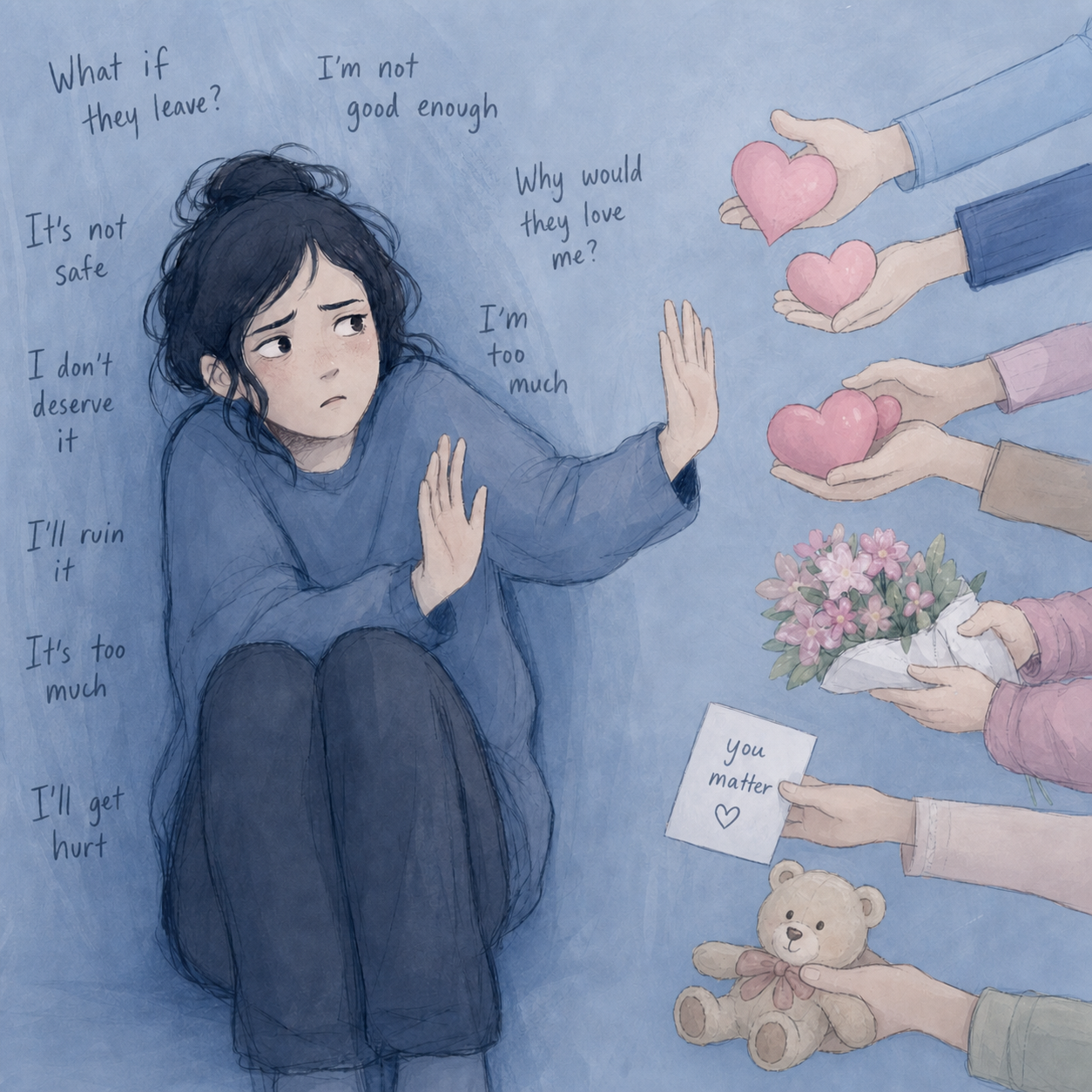 Receiving love can bring a person close to some of their deepest fears. Underneath the difficulty receiving love, there may be a fear of being disappointed again, of depending on someone and feeling less in control, or of needing more than feels safe to need. There may be a fear of being fully known and then rejected, of allowing love to matter and then having it taken away, or of letting someone become so important that the possibility of loss feels unbearable.
These fears are not always spoken out loud. Sometimes they show up as irritation, numbness, anxiety, emotional distance, or the urge to shut down. A person may not consciously think, “I am afraid to receive love.” They may simply feel restless when things are calm, uncomfortable when their partner is kind, or suspicious when the relationship begins to feel steady.
In couples counseling, part of the work is helping both partners understand what is happening beneath the surface. The visible reaction may be withdrawal, defensiveness, or dismissal. The deeper experience may be fear, grief, shame, longing, or a nervous system that does not yet know how to feel safe with consistent care.
Receiving Love Cannot Be Forced
One of the most important things to understand is that receiving love cannot be forced. A partner may have loving intentions. They may want to reassure, comfort, help, or get closer. Yet if their love comes with pressure, frustration, urgency, or criticism, the other person may become even more defended. Love can begin to feel like a demand. Closeness can begin to feel like something they are failing at.
This does not mean the partner who longs for closeness should dismiss their own hurt. Feeling shut out can be painful, especially when love is being offered with sincerity and care. Wanting to reach the person you love and feeling unable to connect with them can feel deeply lonely. Their need for warmth, responsiveness, and emotional connection matters too.
The work is not for one partner to simply wait quietly while the other protects themselves forever. It is for both partners to understand the cycle they are caught in and begin creating a different kind of safety together. Over time, the conversation may shift from, “Why can’t you just let me love you?” to “What happens inside of you when I try to get close?” The more guarded partner may also begin to move from, “I do not need anything,” toward something more honest, such as, “I think I do need comfort, but it feels hard to receive it.”
Over time, this kind of communication can begin to change the emotional tone of the relationship. It creates more room for curiosity instead of blame, and helps both partners understand the pattern with more compassion, more honesty, and less shame.
Learning To Let Love In
 Learning to receive love usually happens slowly. This process may begin in quiet, ordinary moments. A person may practice accepting a compliment without immediately brushing it away, allowing a partner to help with something small, or letting a hug linger a few seconds longer. They may begin to say, “I am having a hard day,” instead of automatically insisting they are fine. They may also practice asking for reassurance directly, then allowing themselves to receive it rather than quickly explaining it away.
Each of these experiences can offer the nervous system something new. Over time, the body learns that support does not always mean danger, and the heart may come to trust that closeness does not have to mean losing control. A person can start to discover that receiving love does not erase their independence, strength, or boundaries. It simply allows care to become part of the relationship, too.
Receiving love does not mean becoming dependent in an unhealthy way, accepting behavior that causes harm, or losing yourself in the relationship. It means developing a greater capacity to notice what you need and to choose how you respond. At times, you may need space. At other times, you may need comfort, reassurance, words, or quiet presence. Healing can help those needs feel less frightening and more understandable, so receiving care becomes something you can approach with more safety, clarity, and self-trust.
How Couples Counseling Can Help
Couples counseling can help partners slow down the patterns that make giving and receiving love feel difficult.
For the partner who struggles to receive love, therapy can offer space to explore earlier experiences, attachment wounds, trauma responses, beliefs, and body-based reactions that make closeness feel unsafe or unfamiliar. It can help them understand why kindness may feel uncomfortable, why support may feel exposing, or why emotional availability may bring up fear instead of relief.
For the partner who feels shut out, therapy can help name the pain of reaching for someone who keeps protecting themselves. It can help them distinguish between true rejection and a protective response while still honoring their need for connection, warmth, and emotional reciprocity.
The work may include communication skills, attachment-focused exploration, nervous system regulation, somatic awareness, trauma-informed therapy, emotional processing, and practical changes in how partners reach for each other. The goal is not for one partner to chase and the other to surrender. The goal is to help both people understand the emotional dance they are in and begin building a relationship in which love feels safer to offer and receive.
When Love Has Somewhere To Land
 A relationship can begin to soften when love has somewhere to land. This does not mean the relationship suddenly becomes easy, or that every wound, fear, or protective response disappears. It means both partners begin to recognize the pattern with more awareness and respond to it with more care. Over time, they may come to understand that the distance between them is not the absence of love. It most likely is fear, history, or protection showing up in the relationship and asking for compassionate attention.
Over time, the person who has struggled to receive love may begin to experience care as steadier, safer, and more trustworthy. The partner offering love may begin to feel more seen, more met, and less alone in their desire for closeness. Together, both partners may begin to create more moments of emotional connection, honesty, tenderness, and repair.
Receiving love is not a small thing. It asks a person to soften in places that may have needed protection for a long time, and it asks a couple to move at the pace of safety rather than pressure. It invites both partners to be more honest about their longing, fear, disappointment, and hope, while learning to meet those tender places with greater care.
A More Open Way To Love
A more open way to love can begin with honoring both the longing for connection and the fear that may come with receiving it. Wanting closeness does not mean trust has to happen all at once, and being independent does not mean care has to be kept at a distance. Over time, old walls that once offered protection can be met with compassion and gently questioned, especially when they begin to keep a person from the connection they deeply want.
In a healthy relationship, love is not only something you give. It is something you are allowed to experience, receive, and slowly let in.
Couples counseling can help you and your partner understand what makes it difficult to receive love, how protective patterns show up between you, and how to build a relationship where care feels safer, steadier, and more possible. If you are in a relationship where it is hard for you to receive love and this blog resonated with you, please book a phone consult today.

When Both Partners Struggle To Receive Love
In many relationships, love is not absent. It is there in the effort, the concern, the loyalty, the reaching, the small gestures, and the desire to feel close. Yet love can still feel strangely difficult to experience when one or both partners have a hard time...