
Parenting can bring out the most tender, protective, loving parts of a person. It can also bring out anxiety in ways that feel surprising, exhausting, and sometimes difficult to explain. A parent may deeply love their child and still feel overwhelmed by worry, flooded by responsibility, or constantly braced for something to go wrong. They may find themselves overthinking decisions, scanning for danger, feeling irritable or overstimulated, or struggling to relax even when everyone is safe. For many anxious parents, the issue is not a lack of love, effort, or insight. It is often that their nervous system has learned to stay on high alert.
From an integrative therapy perspective, anxious parenting is not simply about “thinking too much” or needing to be more positive. Parenting touches some of the deepest parts of the self. It can activate old wounds, unresolved fear, perfectionism, trauma, attachment patterns, identity shifts, medical fears, relationship stress, and the pressure of feeling responsible for another person’s well-being. EMDR therapy can be a powerful approach because it does not only focus on what a parent is thinking in the present. It helps the brain and nervous system process the older experiences, beliefs, and emotional patterns that may be intensifying the anxiety now.
When Parenting Activates Anxiety
An anxious parent may look very capable from the outside. They may be organized, attentive, loving, responsible, and deeply invested in doing things well. Internally, however, they may feel like their mind rarely shuts off.
They may worry about their child’s health, school, friendships, safety, sleep, development, future, or emotional well-being. They may replay conversations, second-guess decisions, compare themselves to other parents, or feel guilty for not being more patient, more present, more calm, or more certain. Even ordinary parenting choices can feel heavy when the nervous system is already activated.
This anxiety can show up in many ways. Some parents become overly vigilant. Some feel panicky when their child is sick, upset, or out of sight. Some struggle with intrusive thoughts, catastrophic images, or a constant sense that something bad could happen. Others become irritable, controlling, avoidant, tearful, or emotionally shut down because their system is carrying more than it can comfortably process.
For many parents, anxiety is not just about the current situation. It is about what the current situation represents internally.
A child’s distress may activate a parent’s old helplessness. A child’s independence may bring up fears of loss or danger. A medical appointment may activate earlier medical trauma. A tantrum may trigger the parent’s own childhood experiences of not feeling safe, heard, or emotionally supported. A school issue may stir up memories of exclusion, shame, or failure. The present moment may be manageable on the surface, but the body may be reacting as if something much bigger is happening.
This is where EMDR can be especially helpful.
What Is EMDR?
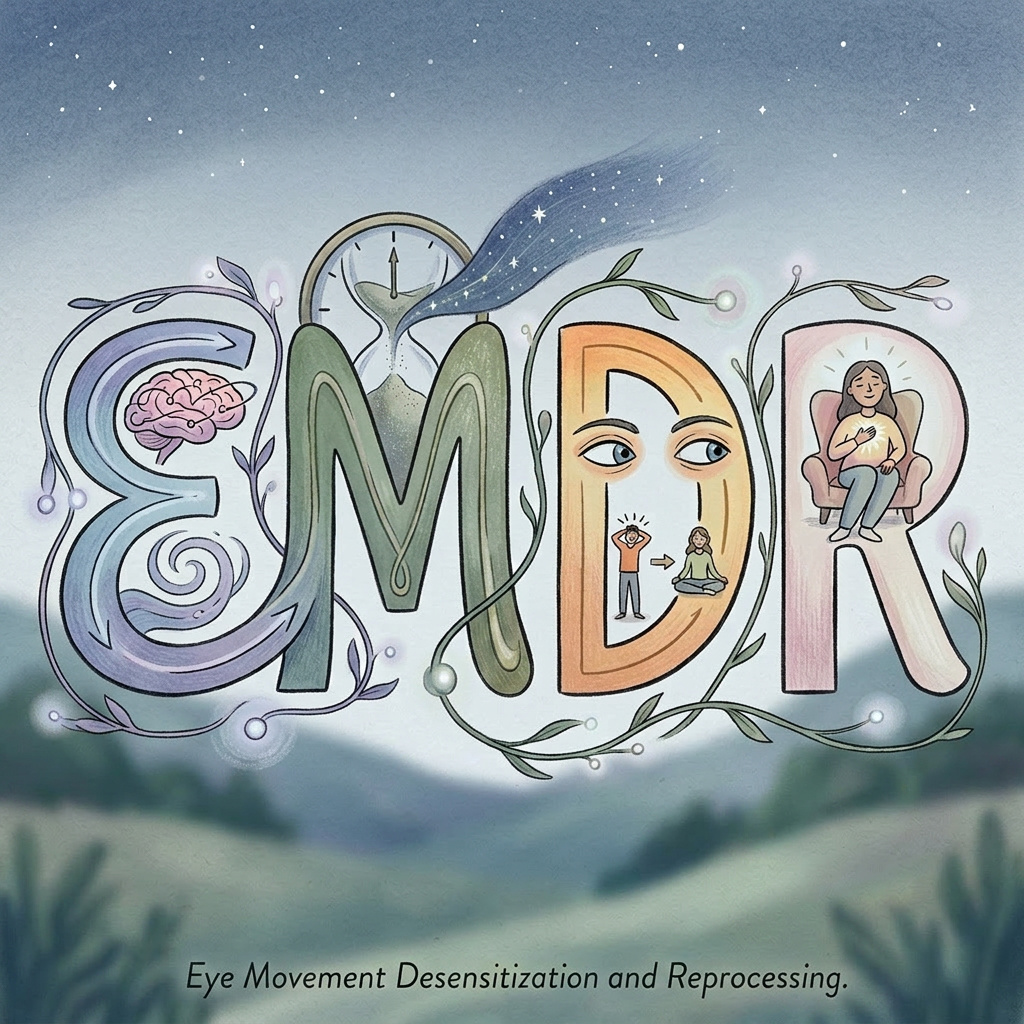 EMDR stands for Eye Movement Desensitization and Reprocessing. It is a research-supported therapy approach that was originally developed to help people process trauma, and it is now used for a wide range of concerns, including anxiety, panic, phobias, grief, performance anxiety, and distressing life experiences.
EMDR helps the brain process experiences that may be stored in a stuck, emotionally charged, or fragmented way. When something feels overwhelming at the time it happens, the brain may not fully integrate the experience. Instead, pieces of the memory can remain highly activated, including body sensations, emotions, beliefs, images, and protective responses. Later in life, something in the present can touch that old network and the body may respond quickly, intensely, and automatically.
For an anxious parent, this might sound like:
- “I know logically my child is okay, but my body does not believe it.”
- “I know I am not a bad parent, but I feel like I am failing.”
- “I know this is a normal childhood issue, but I feel terrified.”
- “I know I need to let them have more independence, but I feel like I cannot tolerate it.”
- “I know I am overreacting, but I cannot calm down.”
EMDR can help close the gap between what a person knows intellectually and what their nervous system feels to be true.
Why Insight Alone Is Not Always Enough
Many anxious parents are very insightful. They may know they are catastrophizing. They may know their standards are unrealistic. They may know that their child’s discomfort is not always an emergency. They may know that uncertainty is part of parenting. But insight does not always calm the body.
A parent may understand that their child going to a sleepover is developmentally appropriate and still feel flooded with dread. They may know that a fever is common and still feel panic rising in their chest. They may know that one difficult school day does not define their child’s future and still spiral into fear.
This is because anxiety is not only cognitive. It is also emotional, somatic, relational, and nervous-system based. The body may be responding from old learning, not present-day logic.
EMDR helps by working with the deeper material that may be feeding the anxiety. It can help process the earlier experiences that taught the nervous system to expect danger, brace for loss, assume responsibility for everyone else’s emotions, or believe that mistakes are not safe.
EMDR And The Anxious Parent’s Nervous System
 Parenting can require a great deal of nervous system flexibility. A parent has to respond to noise, needs, mess, conflict, uncertainty, schedules, emotional intensity, illness, school concerns, financial pressures, and their own internal world at the same time. When a parent’s nervous system is regulated, they have more access to perspective, patience, intuition, problem-solving, and emotional connection. When the nervous system is overwhelmed, even small stressors can feel enormous.
An anxious parent may spend much of the day in a state of sympathetic activation, which can feel like urgency, tension, racing thoughts, irritability, restlessness, or the need to fix everything immediately. Others may move into shutdown, which can feel like numbness, fatigue, avoidance, detachment, or feeling unable to cope.
EMDR can support nervous system regulation by helping the brain reprocess distressing material that keeps the system on alert. As old triggers become less charged, the body may no longer react with the same intensity in present-day parenting moments.
This does not mean a parent becomes perfectly calm all the time. That is not realistic, and it is not the goal. The goal is to have more room inside. More pause. More choice. More ability to notice, “This is hard, but I am here. This is uncomfortable, but it is not the same as the past. My child is struggling, and I can respond without becoming completely flooded.”
The Beliefs That Can Drive Parental Anxiety
One of the powerful parts of EMDR is that it helps identify the negative beliefs that are connected to distressing experiences. These beliefs often live underneath the anxiety and can quietly shape how a parent responds.
An anxious parent may carry beliefs such as:
- “I am not safe.”
- “I cannot handle this.”
- “I have to prevent everything bad from happening.”
- “If I relax, something will go wrong.”
- “I am responsible for everyone’s feelings.”
- “I am failing.”
- “I should have known better.”
- “I cannot trust myself.”
- “My child is not safe unless I am constantly watching.”
These beliefs may not have started with parenting. They may come from childhood experiences, trauma, loss, medical scares, emotionally unpredictable environments, relationship wounds, or past experiences of being unsupported. Parenting then becomes the stage where these beliefs get activated again and again.
Through EMDR, these beliefs can begin to shift. Not by forcing affirmations, but by helping the brain process the experiences that made those beliefs feel true.
Over time, a parent may begin to feel more connected to more adaptive beliefs, such as:
- “I can handle this.”
- “I can respond without controlling everything.”
- “I am a good enough parent.”
- “I can trust myself.”
- “My child can have feelings, and I can stay grounded.”
- “I can protect without living in constant fear.”
- “I can make thoughtful decisions without needing certainty.”
These shifts can feel subtle at first, but they can become deeply meaningful in daily parenting. A parent may notice a little more space between the feeling and the reaction, a little more ability to pause before responding, or a little more trust in themselves during a difficult moment. Over time, these small internal changes can begin to shape the emotional tone of the home, making it easier to respond with steadiness, repair after hard moments, and feel more present with their child.
EMDR Can Help With Parenting Triggers
Many anxious parents have specific triggers that bring on intense emotional reactions. These may include a child getting sick, a child crying, separation, school struggles, driving with children, conflict between siblings, bedtime, social situations, medical appointments, safety concerns, or moments when a child is disappointed or upset.
Sometimes a parent feels confused by the intensity of their own reaction. They may think, “Why did that upset me so much?” or “Why do I feel like this is an emergency?” or “Why can’t I just let this go?”
EMDR can help explore what the trigger is connected to. The trigger may be linked to a specific memory, but it may also connect to a theme. For example, a child crying might activate an old feeling of helplessness. A child being rejected might activate the parent’s own experience of being excluded. A child needing medical care might activate earlier fear, loss, or trauma. A child pushing limits might activate old experiences with anger, punishment, or lack of safety.
When these connections are processed, the present-day trigger often becomes less intense. The parent can respond more to what is happening now rather than reacting from what happened then.
EMDR And The Fear of “Messing Up” Your Child
 Some anxious parents are carrying a quiet but painful fear that they are somehow harming their child by not parenting perfectly. They may worry that every mistake will have lasting consequences. They may feel guilty for losing patience, being anxious, working too much, needing space, getting overwhelmed, or not always knowing what to do.
This kind of anxiety can be heavy because it often comes from love. The parent wants to do well. They want their child to feel safe, loved, understood, and supported. But when love becomes fused with fear, parenting can start to feel like a constant test.
EMDR can help parents process the shame, guilt, and fear that may be attached to this pressure. It can also help create more internal space for repair. A parent does not need to be perfect in order to be deeply supportive. Children benefit from warmth, consistency, repair, responsiveness, and emotional presence. They do not need a parent who never struggles.
When a parent can process some of the fear around imperfection, they often become more available to their child. Not because they are trying harder, but because they are less trapped in self-blame.
EMDR Can Support More Present Parenting
 Anxiety often pulls parents out of the present. It moves the mind into the future, into worst-case scenarios, into what-ifs, and into constant preparation. While some planning is necessary in parenting, anxious planning can become relentless.
A parent may be physically present with their child but mentally scanning for the next problem. They may struggle to enjoy calm moments because their system is waiting for the next difficulty. They may find themselves unable to receive the sweetness of parenting because worry keeps interrupting connection. as EMDR helps reduce the charge around triggers and old emotional learning, many parents find they have more access to the present moment. They may still have concerns, but those concerns do not take over as quickly. They make thoughtful, careful decisions, but from a place that feels more grounded and less driven by fear. They still protect their child, but with less internal urgency.
This can create more room for play, affection, humor, curiosity, and connection. Parenting may still be hard, but it can begin to feel less dominated by fear.
EMDR Is Not About Blaming The Past
Sometimes parents worry that if therapy explores earlier experiences, it means blaming their childhood, their family, or their past. EMDR is not about blame. It is about understanding how the nervous system learned to protect itself and helping it update.
Many anxious responses made sense at some point. Hypervigilance may have once helped someone stay emotionally or physically safe. Over-responsibility may have developed in an environment where the parent, as a child, had to monitor other people’s moods. Perfectionism may have been a way to avoid criticism. Emotional shutdown may have helped someone survive overwhelm. These responses are not character flaws. They are adaptations.
The problem is that old adaptations can become exhausting when they continue running in present-day parenting. EMDR helps the system process what it has been carrying so that a parent has more freedom to respond from the present rather than from old protection.
EMDR As Part Of Integrative Therapy
In integrative therapy, EMDR can be combined with other approaches depending on what the parent needs. Some parents benefit from nervous system education, somatic therapy, parts work, cognitive behavioral therapy, mindfulness, self-compassion practices, attachment-focused work, or practical parenting support. For example, CBT (cognitive behavioral therapy) may help a parent recognize catastrophic thinking patterns. Somatic therapy may help them notice early signs of activation in the body. Parts work may help them understand the protective part that wants to control everything. EMDR may help process the memories and emotional material that keep those patterns highly charged.
This kind of integrative approach can be especially helpful because parental anxiety usually has more than one layer. There may be present-day stressors, old experiences, body-based fear, relationship dynamics, identity changes, and practical parenting demands all happening at once. The goal is not to use one technique for everything. The goal is to understand the whole person.
What Healing Can Look Like
Healing parental anxiety does not mean a parent stops caring. It does not mean they become detached, overly relaxed, or unconcerned. It does not mean they never worry again.
Often, healing looks more like being able to notice worry without being consumed by it. It looks like pausing before reacting. It looks like offering comfort without becoming flooded. It looks like magnifying uncertainty with more steadiness. It looks like letting a child have an emotion without immediately needing to fix it. It looks like trusting that repair is possible after difficult moments.
Healing may also look like more kindness toward yourself as a parent. Less shame. Less urgency. Less belief that every hard moment means you are failing. More capacity to say, “This is a difficult parenting moment, and I can move through it.”
A parent may begin to feel less controlled by old fear and more connected to their own wisdom. They may become more able to protect their child without over-functioning, support their child without absorbing every feeling, and guide their child without needing everything to feel certain.
A Gentle Reminder
 If you are an anxious parent, it may be important to know that your anxiety is not proof that you are doing something wrong. Often, it is a sign that you care deeply and that your nervous system is working very hard to protect what matters most to you.
EMDR therapy can help you understand and process the deeper roots of that anxiety so parenting does not have to feel so flooded, pressured, or fear-driven. With the right support, it is possible to feel more grounded in yourself, more present with your child, and more able to move through parenting challenges with steadiness and self-trust.
If parental anxiety has been affecting your daily life, your relationships, or your ability to feel present with your child, integrative therapy with EMDR may be a meaningful place to begin. If this blog post resonated with you, please schedule a phone consult.